










Blogs > AEO vs GEO: Main Differences You Can't Ignore in 2026
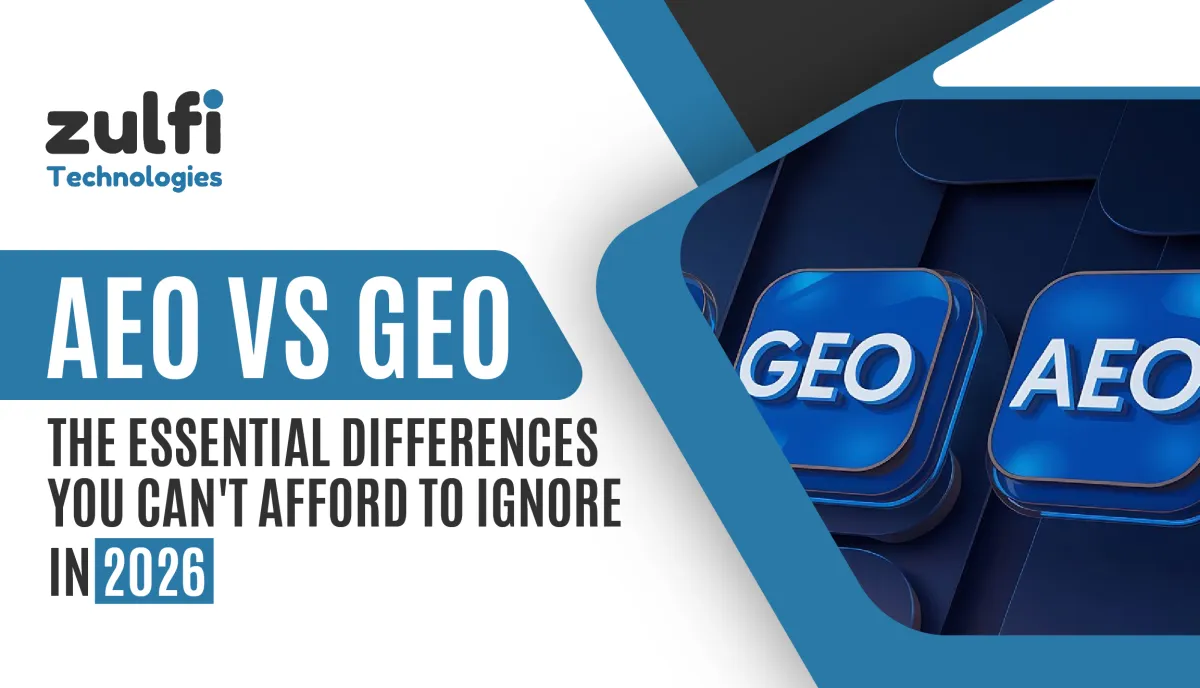
AEO vs GEO: The Essential Differences You Can't Afford to Ignore in 2026
Published: April 22, 2026

F. Zulfiqar
CEO Zulfi.tech



Most Marketers Are Using These Terms Wrong
AEO. GEO. You've probably seen both terms in the same breath, maybe even used interchangeably in a LinkedIn post or two. The problem is, they're not the same thing. Not even close.
And in 2026, with AI reshaping how people find information every single day, confusing these two isn't just a terminology issue. It's a strategy issue. One that quietly chips away at your search visibility while you're busy optimizing for the wrong thing.
This post exists to fix that. No fluff, no detours, just the essential differences between AEO and GEO, explained clearly enough that you can act on them today.
What GEO Actually Means
Generative Engine Optimization (GEO) operates on completely different logic.
GEO is about getting your brand cited, referenced, or included when AI tools, ChatGPT, Perplexity, Google's AI Overviews, Bing Copilot, generate a response to a user's query. These platforms don't retrieve a single answer from a single page. They synthesize information from multiple sources and produce something new. GEO is the practice of becoming one of those trusted sources.
The core idea: be part of the answer. Not the one result, one of the voices the AI draws from.
Where AEO rewards tight, structured content, GEO rewards authority, depth, and credibility. It's less about format and more about whether an AI model considers your content trustworthy enough to build on.
The 5 Differences That Actually Matter
This is where it counts. AEO and GEO look related because they both involve AI and search. But underneath that surface similarity, they're built on fundamentally different principles.
1. The Platforms They Target
AEO targets search engines and voice assistants, Google, Bing, Siri, and Alexa. These platforms retrieve existing content and surface it as-is in response to a query.
GEO targets generative AI platforms, ChatGPT, Perplexity, and Google AI Overviews. These platforms don't retrieve; they generate. They take in multiple sources and write a fresh response.
That single distinction flows through every other difference on this list.
2. The Content They Reward
AEO rewards structure and brevity. Clear question-and-answer formatting. FAQ schema. Concise answer blocks of 40–60 words. Content that a search engine can extract cleanly and display without any surrounding context.
GEO rewards depth and authority. Comprehensive coverage, original research, expert insights, proper citations. Content that reads like something worth referencing, because generative AI is doing exactly that when it includes you in a response.
3. The Queries They Serve
AEO handles specific, direct questions with factual answers. "What is AEO?" "How does voice search work?" One question, one right answer.
GEO handles exploratory, research-driven queries. "What should I know about AEO and GEO before updating my content strategy?" These queries don't have one answer; they have a conversation. GEO gets your brand into that conversation.
4. How You Measure Success
AEO success is visible and trackable. You either hold the featured snippet, or you don't. Google Search Console shows you snippet wins, People Also Ask appearances, and voice-eligible content signals.
GEO success requires different tools. Platforms like Profound and Goodie AI track how often your brand appears in AI-generated responses. Manual testing, querying ChatGPT or Perplexity with your target questions, gives you a direct read on your generative visibility. The metrics are newer, but they exist.
5. The Role of Knowledge Graphs
For AEO, knowledge graphs are central. Google's Knowledge Graph maps entities, brands, people, places, concepts, and their relationships. The more clearly your brand exists as a defined, credible entity in that graph, the more often it gets pulled into answer placements. Structured data and entity optimization are core AEO tactics precisely because of this.
For GEO, the relationship is more indirect. AI models aren't reading your schema markup. They're influenced by overall brand authority, third-party citations, and how consistently your content is referenced across credible sources. The knowledge graph still plays a background role, but it's brand trust, not entity structure, that drives GEO performance.
AEO vs GEO: The Essential Comparison
| Feature | AEO | GEO |
|---|---|---|
| Stands for | Answer Engine Optimization | Generative Engine Optimization |
| Targets | Google, Bing, Siri, Alexa | ChatGPT, Perplexity, AI Overviews |
| Core goal | Be the direct answer | Be cited in generated responses |
| Content style | Structured, concise, extractable | In-depth, authoritative, well-cited |
| Query type | Direct, specific questions | Exploratory, research-based queries |
| Key tactics | Schema markup, Q&A format, featured snippets | Thought leadership, citations, original research |
| Success metric | Snippet wins, voice placements | AI brand mentions, citation frequency |
Book a Consultation
Build a Smart AI Content Roadmap Today
Plan your content-structured AI roadmap that ensures consistent performance and engagement.
The Mistake Most Brands Are Making Right Now
The most damaging misconception about AEO and GEO is treating them as interchangeable, like two words for the same optimization job.
A page built purely for AEO, tight answer blocks, FAQ schema, stripped down for extractability, often lacks the depth that generative AI platforms need to trust and cite it. It wins the snippet but never makes it into a ChatGPT response.
A long-form authoritative piece built with GEO in mind, but without any structured Q&A formatting or schema, won't get extracted as a featured snippet or read aloud by a voice assistant, no matter how good it is.
They are different disciplines that require different content decisions. Understanding that is the first step. Building content that serves both, structured enough for AEO, deep enough for GEO, is the goal.
We help businesses earn trust across search, content, automation, and AI experiences. Our focus stays practical, clear, and accountable, so progress remains visible and performance improves steadily over time.
Custom App Development
We help businesses earn trust across search, content, automation, and AI experiences. Our focus stays practical, clear, and accountable, so progress remains visible and performance improves steadily over time.
Custom App Development
Book a Consultation
The Difference Is Clear. The Question Is Whether You Act on It.
AEO gets you selected as the answer. GEO gets you included in the answer. These are not the same outcome, and they don't come from the same strategy.
In 2026, both matter because search has split across more AI-powered surfaces than ever before. Understanding exactly what separates AEO from GEO isn't an academic exercise. It's the starting point for building content that actually gets found, in all the places people are now looking.
Now you know the difference. Use it.
Frequently Asked Questions
What is the difference between AEO and GEO?
AEO (Answer Engine Optimization) targets traditional and voice search engines, getting your content selected as a direct answer in Google or read aloud by Siri or Alexa. GEO (Generative Engine Optimization) targets AI platforms like ChatGPT and Perplexity, getting your brand included when those tools generate a response.
Is GEO the same as generative engine optimization?
Yes. GEO stands for Generative Engine Optimization. It specifically refers to optimizing your content and brand so that large language models and AI-powered search tools cite or reference you in their generated responses.
Can the same content work for both AEO and GEO?
Yes, if it's built intentionally for both. Content that pairs clear Q&A structure and schema markup (for AEO) with genuine depth, expert insights, and proper citations (for GEO) can perform well on both fronts. It requires more thought upfront, but delivers visibility across multiple AI-powered surfaces.
Does AEO include voice search optimization?
Yes. Voice search is a subset of AEO. Voice assistants pull answers from the same structured, answer-ready content that feeds featured snippets and knowledge panels. Strong AEO automatically covers voice search.
How do I measure GEO performance?
Query AI tools like ChatGPT, Perplexity, and Google AI Overviews with questions in your category and check whether your brand appears. Tools like Profound and Goodie AI automate this tracking at scale. It's a newer measurement area, but it's increasingly trackable.
Which is more important, AEO or GEO?
In 2026, both matter. AEO drives real, measurable traffic through Google and voice. GEO shapes how AI tools represent your brand to the growing share of users who start their research in ChatGPT or Perplexity rather than a traditional search engine. Choosing one over the other means ignoring a significant portion of how people find information today.

About author
I am a passionate writer with a strong interest in IT and marketing, focused on sharing practical ideas in simple and clear language. I enjoy helping readers understand technology and marketing concepts easily, making them useful for everyday work and growth.



Let's Connect With Our Experts
Book a Consultation
Stop Losing Deals to
Manual Work. Start Today.
14-day free trial. Full platform access. No credit card required. Setup in under 30 minutes.

AI-powered digital marketing solutions for businesses ready to dominate search and AI-driven discovery.
Copyright© 2026 Zulfi Technologies. All rights reserved.