







Blogs > AI in Digital Marketing: The Practical Smart Growth Guide
AI in Digital Marketing: The Ultimate Guide to Smart Growth Before Your Competitors Do
Published: June 24, 2026

F. Zulfiqar
CEO Zulfi.tech


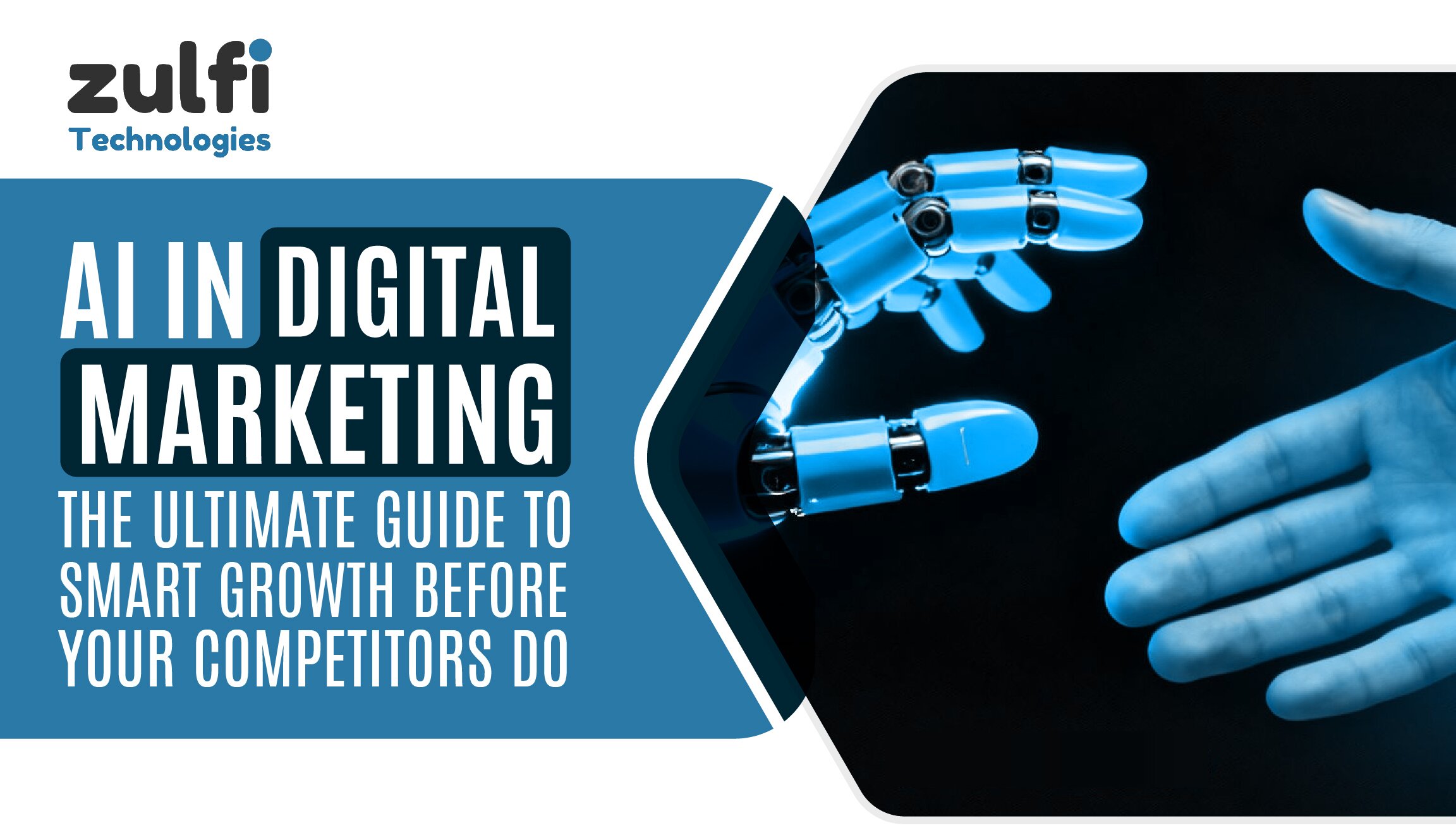

Technology in digital marketing has always rewarded the bold, but AI is moving faster than any shift before it. Brands using it strategically are pulling ahead in personalization, lead quality, campaign efficiency, and content output. The ones still watching are falling behind in all four.
This isn't a guide about whether to use AI in your digital marketing. That decision is already made for you by the competitive landscape. This is about how to use it smartly, and how to measure whether it's actually working.
The Real Pros of AI in Marketing
When the pros and cons of AI in marketing come up, the benefits usually get listed without much context. Here's what actually matters in practice.
Personalization and Audience Understanding at Scale
Personalization and digital marketing have always been natural partners, but execution at scale was the problem. AI solves it. By processing behavioral signals across thousands of users simultaneously, AI tools adjust messaging, content, and offers for individual users in real time.
Beyond personalization, audience understanding with AI goes deeper than demographics. It surfaces which content formats drive engagement, which messages move specific segments, and when different audience profiles are most likely to convert. That kind of insight used to require a research team. Now it runs in the background automatically.
Smarter Lead Generation
Best practices for lead generation in the AI era center on timing and intent rather than volume. AI identifies high-intent behavioral signals, extended product page visits, return sessions, specific content consumption, and triggers outreach at the moment a prospect is most receptive. Fewer wasted conversations, higher conversion rates, same lead volume.
Faster, More Effective Campaigns
AI-powered advertising campaigns run more efficiently because they optimize themselves. Bidding, targeting, budget allocation, and creative testing all improve with less manual input. For any AI marketing agency aiming to deliver results at scale, this automation layer is what makes it possible.
The Cons Worth Taking Seriously
The cons of AI in digital marketing don't get enough honest coverage. Here are the ones that actually affect performance.
Data quality dictates everything. AI amplifies whatever it's fed. Poor CRM data, broken tracking, and thin first-party data all produce worse outputs at faster speeds. Before any AI implementation, data quality is the audit that can't be skipped.
Brand voice suffers without editorial judgment. AI content generation scales output but tends toward being generic. Marketers who rely on it wholesale without human review end up with more content that says less, and audiences notice.
Implementation is underestimated almost universally. Key challenges in implementing AI for marketing aren't technical. They're organizational, team training, workflow integration, and governance decisions about how AI outputs are reviewed. The brands that struggle most are the ones that treated AI adoption as a tool purchase rather than an operational change.
Choosing AI Optimization Software That Actually Performs
Knowing what to consider when selecting AI optimization software is what separates a productive implementation from an expensive one.
Start with the problem, not the product. "We need AI" isn't a brief. "We need to improve email engagement rates," or "We need to qualify leads faster" is. That specificity shapes every evaluation that follows.
Then review integration before features. Digital marketing intelligence tools are only as useful as their ability to connect to the systems you already run, such as CRM, email platform, and analytics stack. A powerful standalone tool that doesn't sync cleanly creates more friction than it removes.
Finally, require evidence of real business outcomes. Ask vendors how businesses measure AI marketing effectiveness in their platform, not usage stats, but conversion rate changes, cost per acquisition shifts, and pipeline impact. If a vendor leads with features rather than results, that's worth noting.
AI-Driven Email and Content: What to Analyze
How to review AI-driven email suggestions is a question more marketing teams should be asking before they automate. The evaluation criteria are straightforward: does the suggestion reflect your brand voice, does it align with where this contact is in the buying journey, and does it improve on what a human would have written, or just replace it with something average?
On the content side, artificial intelligence as a content marketer's guide to natural language generation works best when it handles volume and speed, first drafts, subject line variations, and product descriptions, while human judgment handles strategy, positioning, and anything where the specific voice of the brand is the value.
Tracking AI Search Marketing Campaign Results
AI search marketing campaign results tracking requires a different framework than traditional analytics. UTM parameters and last-click attribution don't capture brand impressions generated inside ChatGPT, Perplexity, or Google AI Overviews.
How to stay relevant in the world of AI search means building measurement infrastructure that accounts for AI-driven visibility, share of AI voice, citation frequency, sentiment in generated responses, alongside traditional performance metrics.
Campaigns that build AI search brand presence but don't show in direct traffic still drive buyer awareness. Measurement needs to reflect that reality.
We help businesses earn trust across search, content, automation, and AI experiences. Our focus stays practical, clear, and accountable, so progress remains visible and performance improves steadily over time.
Custom App Development
We help businesses earn trust across search, content, automation, and AI experiences. Our focus stays practical, clear, and accountable, so progress remains visible and performance improves steadily over time.
Custom App Development
Frequently Asked Questions
What are the main pros and cons of AI in marketing?
The key advantages are speed, personalization at scale, smarter lead generation, and more efficient campaigns. The main risks are data quality dependency, loss of brand voice without editorial oversight, and the operational complexity of implementation.
How do businesses measure AI marketing effectiveness?
Through business outcomes, conversion rate changes, cost per acquisition, pipeline velocity, and revenue attribution. Measuring tool usage without connecting it to results tells you very little about whether AI is working.
What should I consider when selecting AI marketing tools?
Define the specific problem first. Then evaluate integration capability, data requirements, and the vendor's ability to demonstrate measurable outcomes for comparable businesses.
Will AI replace digital marketers?
No. It automates the repeatable and data-heavy. Strategic thinking, creative judgment, and brand building remain human work, and become more valuable as AI handles everything around them.
Book a Consultation
Move Deliberately. Move Now.
The competitive advantage from AI in digital marketing doesn't come from having the most tools. It comes from using the right ones with clarity about what they're for and discipline about how you measure results.
The brands that get ahead in 2026 aren't moving the fastest. They're moving with the most intention. That's still an open opportunity, but the window for it is narrowing.

About author
I am a passionate writer with a strong interest in IT and marketing, focused on sharing practical ideas in simple and clear language. I enjoy helping readers understand technology and marketing concepts easily, making them useful for everyday work and growth.



Let's Connect With Our Experts
Book a Consultation
Speed Is a Ranking Strategy.
Treat It Like One.
Site speed is often treated as a technical housekeeping task. Something to sort out, tick off, and move past. That framing misses what's actually at stake.
Page speed runs through almost every signal Google uses to evaluate a page, how efficiently it's crawled, how users engage with it, and how it scores on the metrics built directly into the ranking algorithm.
The fastest-loading websites didn't get there by accident. They got there by treating speed as a core part of their SEO strategy, not an afterthought. In 2026, that's the standard worth holding yourself to.

AI-powered digital marketing solutions for businesses ready to dominate search and AI-driven discovery.
Copyright© 2026 Zulfi Technologies. All rights reserved.