

Blogs > How to Measure SEO Performance in the Age of AI Overviews.
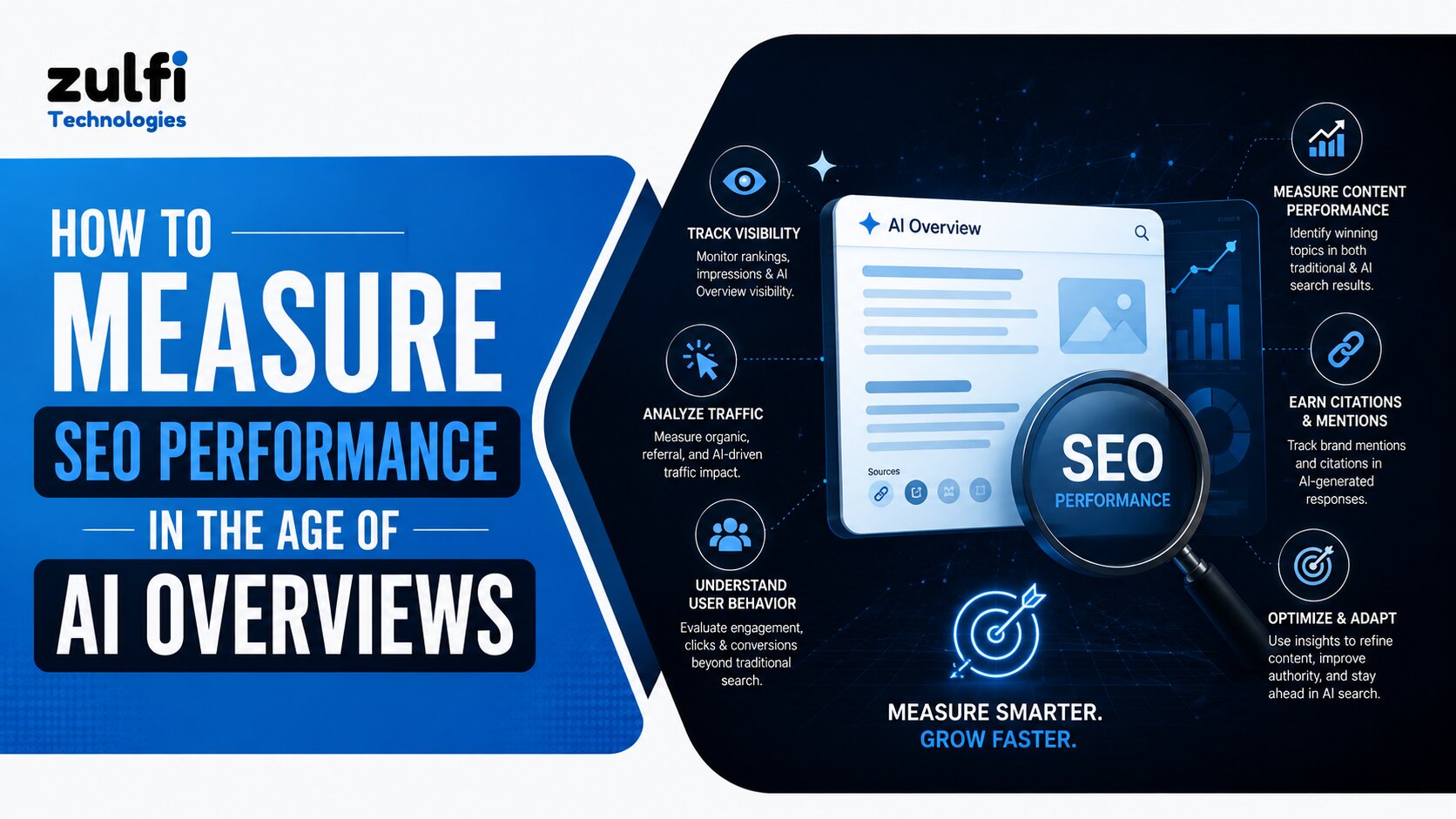
How to Measure SEO Performance in the Age of AI Overviews.
Published: August 20, 2026

F. Zulfiqar
CEO Zulfi.tech



Your traffic is down. Your rankings look fine. What happened?
If you've asked that question this year, you're not imagining things. A 2026 study from Seer Interactive tracking 5.47 million queries found organic click-through rate on AI Overview pages fell from 1.76% to 0.61% — a 61% decline. Ahrefs found something similar: a 58% CTR drop for the very top-ranking page once an AI Overview appeared above it.
The old scoreboard — rank higher, get more clicks, done — doesn't tell the whole story anymore. This guide walks through what to measure instead, and why.
Key Takeaways
Organic CTR on AI Overview queries dropped 61% in a 2026 Seer Interactive study of 5.47M queries, while branded queries actually gained clicks.
68% of U.S. Google searches now end without any click, up from 60% in 2024, per SparkToro/Similarweb data.
Rankings and sessions alone can no longer prove SEO is working — impressions, brand search volume, AI citation rate, and conversion quality now matter just as much.
Being cited inside an AI Overview correlates with a 35% organic CTR lift versus not being cited on the same query.
Why Traditional SEO Metrics Are Losing Their Grip
Clicks used to be a fair proxy for value: rank well, get visited, count the visit. That chain has broken. A Pew Research panel study found only 8% of users click through to organic results when an AI Overview appears, versus 15% when it doesn't.
It gets broader than AI Overviews specifically. Even on queries with no AI Overview at all, organic CTR still fell 41% — evidence that people are simply clicking less everywhere, likely due to habits formed on ChatGPT and other AI platforms. That's the uncomfortable part: you can't fix this by chasing AI Overview queries alone, because the click habit itself is shifting.
None of this means SEO stopped working. It means the finish line moved from "did they click" to "did they see us, trust us, and eventually come to us." Measuring that requires a wider net.
How Much Has AI Overviews Actually Cut Into CTR?
The honest answer: a lot, but not evenly, and the picture is still moving. Ahrefs' study found a 58% CTR reduction specifically for position-one organic results when an AI Overview appeared above them, which matters because it shows ranking #1 no longer guarantees the click volume it once did.
The damage also isn't uniform across query types. Informational and educational queries with AI Overviews saw a 61% decline in CTR — the steepest drop in the dataset — while branded queries actually gained 18.7% in CTR. That split is the single most useful thing to internalize: AI Overviews punish generic "what is X" content and reward queries where your brand name is already in the search bar.
There's also a recovery wrinkle worth watching. The same large-scale Seer Interactive dataset showed organic CTR on AI Overview-present queries actually rebounded from 1.3% in December 2025 to 2.4% by February 2026, alongside a similar rise on non-AIO queries. Translation: the freefall phase seems to be leveling into a "new normal" rather than a bottomless decline — but that new normal still sits well below pre-AI Overview baselines.
Replacing Clicks as the Core Metric?
The short answer: impressions, brand search, and AI citation rate — tracked together, not separately. When clicks decline, impressions become the more stable metric, since Google Search Console reports impressions for every query where your content appears, regardless of whether anyone clicks.
Brand search volume deserves special attention here. If your content is being cited in AI Overviews and featured snippets, you should see a rise in branded searches as users become aware of your business through zero-click exposure. Flat brand search alongside rising impressions is a warning sign — people are seeing you but not remembering you.
Set up a simple monthly tracking sheet with these four columns:
Impressions (Search Console) — are you still being shown, even without clicks?
Branded query volume (Search Console, filtered to your brand terms) — is exposure turning into recall?
AI citation rate — how often do you show up inside AI-generated answers?
Assisted conversions — are the fewer visitors you do get converting at a higher rate?
That last point matters more than it sounds. Users who click through after reading an AI Overview summary have already done initial research, making them higher-intent visitors — so a 23% better conversion rate can offset some of the raw traffic loss. Isn't that the real question anyway — not how many people showed up, but how many of them actually mattered?
How Do You Track Visibility Inside AI Overviews and Chatbots?
Start with a defined prompt set, run consistently. The standard method is to run a fixed set of category-relevant prompts across your target AI platforms, count how many responses mention your brand, divide by the total number of responses, then multiply by 100 to get your AI Share of Voice for that prompt set.
Build that prompt list deliberately rather than guessing. Include brand-specific queries, category queries like "best [category] tools," direct comparison queries, and problem-based queries phrased the way real buyers ask, organized by awareness, consideration, and decision stage. Twenty-five to fifty prompts is a workable starting size — enough to spot patterns without becoming unmanageable to track by hand.
Don't assume you're invisible if your rankings look strong. AthenaHQ's State of AI Search 2026 report found the average brand mention rate across AI answers sits at just 17.2%, with top-performing companies reaching far higher — meaning most brands showing up fine in classic search results are still largely absent from AI-generated answers.
Note that different platforms behave differently, so aggregate numbers can mislead you. A 2026 measurement framework analyzing over 21,000 citations found Perplexity cites more sources per prompt but with lower per-source influence on the final answer, while ChatGPT cites fewer sources but extracts more content from each one it does cite. Track platforms separately before you average them.
For anyone without budget for a dedicated AI-visibility platform, a manual quarterly audit — running your prompt list by hand across ChatGPT, Perplexity, and Gemini and logging the results in a spreadsheet — gets you a usable baseline. Tools built for this (LLM Pulse, Trakkr, HubSpot's AEO features, and similar) automate the same process at scale once volume justifies the cost.
How Big Is the Zero-Click Problem, Really?
Bigger than most dashboards admit, and it predates AI Overviews. Google searches ended without a click 68.01% of the time in the U.S. during the first four months of 2026, up from 60.45% in 2024 — a 7.56 percentage-point increase in two years.
AI Overviews concentrate that effect further. Searches that trigger an AI Overview show roughly 83% zero-click rates, versus around 60% on traditional results pages, and even when a source is cited inside the summary its click-through sits around 1% compared to roughly 8% for a traditional snippet citation.
This is where a lot of SEO reporting quietly breaks down: if you only report sessions, you're reporting a shrinking slice of a much bigger picture. A more honest dashboard separates "did we appear" (impressions, AI citation rate) from "did they click" (CTR, sessions) from "did it convert" (assisted conversions, branded search lift) — because in 2026, the first metric is often healthy while the second one bleeds.
We help businesses earn trust across search, content, automation, and AI experiences. Our focus stays practical, clear, and accountable, so progress remains visible and performance improves steadily over time.
In this article
Custom App Development
FAQ: Measuring SEO in an AI Overview World
Is SEO still worth measuring if clicks keep falling?
Yes — the discipline of ranking well and being cited is still what determines whether AI systems and Google surface you at all. Cited brands see roughly 35% higher organic CTR and 91% higher paid CTR than non-cited brands competing on the same queries, so visibility inside AI answers still translates to real traffic advantage.
What's a realistic replacement for click-through rate as a top-line KPI?
Track AI Share of Voice alongside impressions and branded search volume rather than any single number. AI Share of Voice measures your brand's mentions as a share of all mentions for a tracked competitor set across a defined prompt set, reporting mention frequency, position, and competitive context.
Does losing CTR always mean losing revenue?
Not necessarily — the visitors who remain may be worth more per visit. Clicks that survive an AI Overview convert roughly 23% better, since those users have already read a summary and are actively seeking deeper information. Falling sessions and stable or rising revenue can coexist.
How often should I re-run my AI visibility audit?
Monthly is the minimum standard for anything competitive. Daily monitoring is considered the minimum standard for reacting in time, since AI Share of Voice can't be measured with traditional SEO tools and requires platforms that execute prompts systematically and record mentions with enough granularity. If you're auditing manually, monthly is a reasonable floor; quarterly is the bare minimum before you lose the ability to spot a trend.
Are zero-click searches actually worthless to a business?
No — treat them as brand exposure, not dead impressions. A basic value framework treats zero-click impressions as: Impressions × Visibility Rate × Brand Recall Factor × Later Conversion Rate × Customer Value, which is a useful way to justify continued investment in content that ranks well but rarely gets clicked directly.
Bringing It Together
Nobody's SEO strategy failed just because a CTR chart went down and to the right this year — that's happening industry-wide. What separates teams that panic from teams that adapt is whether their reporting caught up to the new reality: impressions plus brand search plus AI citation rate plus conversion quality, read together, instead of one shrinking click number read alone.
Pull your last twelve months of Search Console data this week. Split it into AI Overview-present queries versus everything else. If your impressions are steady but clicks are down, you're not losing — you're just being measured on the wrong scoreboard. Build the new one.
Book a Consultation
Let Zulfi Tech Elevate Your Local Business Visibility
Partner with our experts to implement AI search optimization strategies that place your business at the forefront

About author
I am a passionate writer with a strong interest in IT and marketing, focused on sharing practical ideas in simple and clear language. I enjoy helping readers understand technology and marketing concepts easily, making them useful for everyday work and growth.


Let's Connect With Our Experts

AI-powered digital marketing solutions for businesses ready to dominate search and AI-driven discovery.
Copyright© 2026 Zulfi Technologies. All rights reserved.