


Blogs > The Zero-Click Search Era: How Businesses Can Still Win in Google Search
The Zero-Click Search Era: How Businesses Can Still Win in Google Search
Published: August 06, 2026
F. Zulfiqar
CEO Zulfi.tech


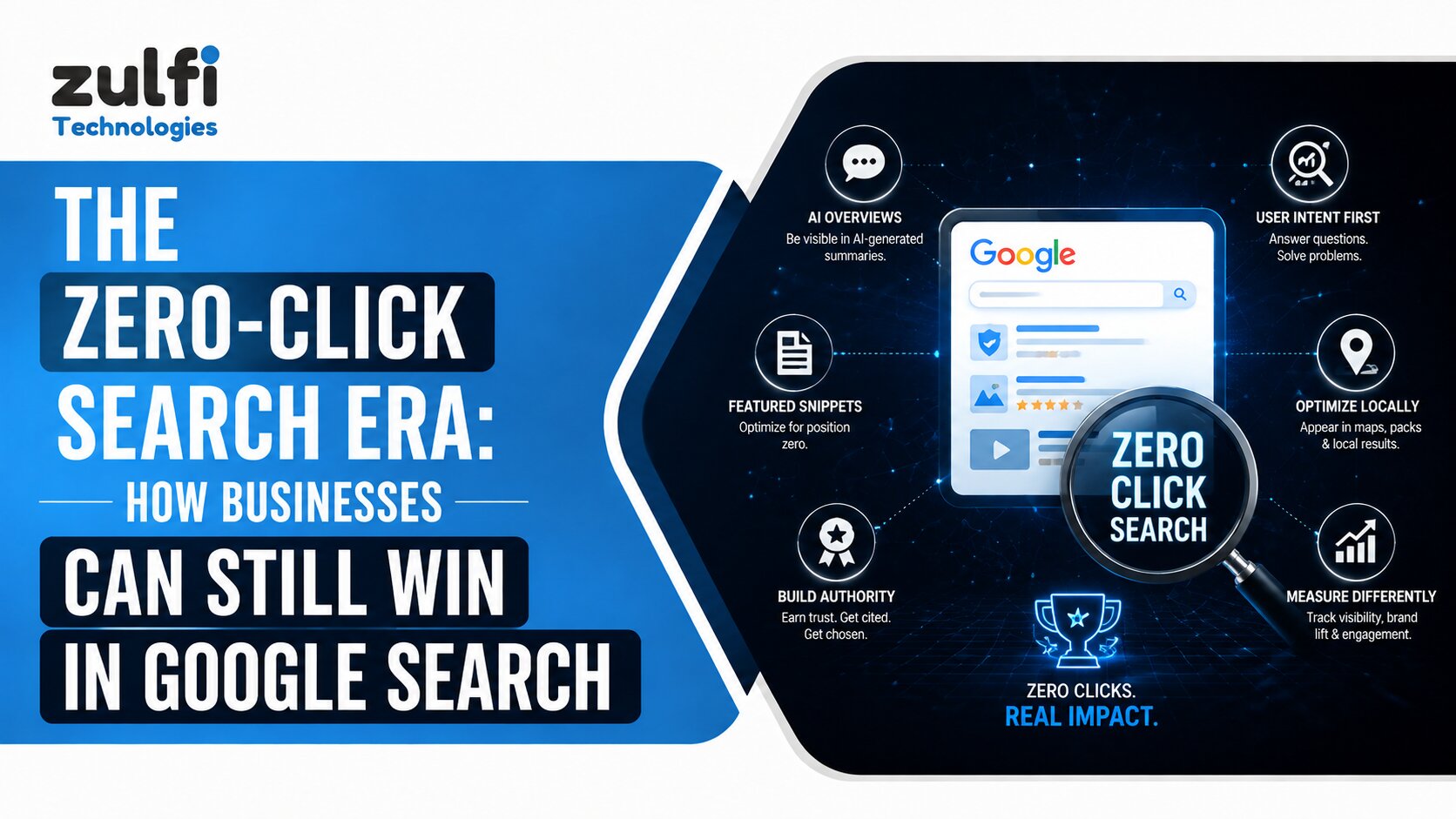

Type a question into Google today, and there's a good chance you'll never leave the page. In early 2026, 68.01% of U.S. Google searches ended without a single click to any website, according to a joint SparkToro and Similarweb study covering January through April 2026 — the fastest two-year acceleration on record for zero-click behavior (SparkToro/Similarweb, 2026). For businesses that built their marketing around organic traffic, that's not a future risk. It's this quarter's traffic report.
The click isn't coming back. But visibility isn't dead — it's just moved. This guide breaks down what's actually happening to search traffic in 2026, why it's happening, and the specific moves that still work when Google, and increasingly ChatGPT and Perplexity, answer the question before anyone reaches your site.
Key Takeaways
68% of U.S. Google searches now end with zero clicks, and organic CTR drops as much as 61% when an AI Overview appears (SparkToro/Similarweb; Seer Interactive, 2026).
Branded queries and AI-cited pages are gaining visibility even as informational content loses clicks — the split between winners and losers is wide.
Answer Engine Optimization (AEO) — structuring content to be extracted and cited, not just ranked — is now a visibility requirement, not an experiment.
Diversifying beyond organic rank, toward citations, brand mentions, and community/video surfaces, is the only strategy showing durable results.
What Is a Zero-Click Search, and How Big Is the Problem in 2026?
A zero-click search is any query that Google answers directly on the results page — through an AI Overview, featured snippet, knowledge panel, or direct answer box — without the user visiting an outside site. In 2026, this is no longer an edge case. It's the majority outcome: SparkToro and Similarweb found that only 276 of every 1,000 U.S. searches now reach the open web in the first four months of the year, down from the roughly 360-per-1,000 ratio measured just two years earlier (SparkToro/Datos, 2024–2026).
This trend didn't start with generative AI. Zero-click behavior has been climbing since featured snippets matured, moving from roughly 50% in 2019 past 60% by 2024. What changed is the slope. Google's AI Overviews now sit on a large share of informational queries, and search behavior researchers describe the last two years as the fastest acceleration they've measured. The practical implication for business owners: ranking #1 no longer guarantees a visitor. It increasingly guarantees a mention inside an answer someone never scrolls past.
Not every query behaves the same way, though. Research from AI Overview studies shows queries that actually trigger an AI Overview hit zero-click rates near 83%, compared to about 60% for traditional queries without one — meaning the format of the query, not just its topic, now determines whether a click is even possible.
Why Are AI Overviews Crushing Organic Click-Through Rates?
A large-scale 2026 study from Seer Interactive, covering 53 brands, 5.47 million tracked queries, and 2.43 billion impressions, found organic click-through rate falls from 1.62% to 0.61% on queries where an AI Overview appears — a 61% compression (Seer Interactive, AIO Impact on Google CTR: 2026 Update). Ahrefs' separate analysis of 300,000 keywords found top-ranking pages lose 58% of their CTR once an AI Overview shows up, and Pew Research's panel study put the click rate at just 8% with an AI Overview present, versus 15% without one.
That said, the picture isn't a straight line down. Seer Interactive's most recent data shows organic CTR on AI-Overview queries actually climbed from a floor of 1.3% in December 2025 to 2.4% by February 2026 — evidence that the steepest damage may already be behind us, even if pre-AI click rates aren't coming back.
Which Businesses Are Losing the Most, and Which Are Gaining Ground?
The zero-click era doesn't hit every business the same way, and that's the part most coverage misses. Informational and educational queries are losing 34% to 61% of their clicks depending on the study, while branded searches with an AI Overview present are actually gaining click-through — because the summary adds context that builds confidence rather than substituting for a visit.
Site size matters too. Analysis from ALM Corp found organic click share fell 11 to 23 percentage points across the verticals it tracked, with the sharpest declines concentrated in sites ranked roughly 100th to 10,000th, not the top 10. The top 10 sites in a given category actually grew organic share by about 1.6% over the same period — a sign that the AI Overview era is consolidating traffic toward already-dominant brands rather than spreading it evenly.
That divergence shows up starkly at the category level. Headphones fell from 73% organic click share to 50%. Jeans dropped from 73% to 56%. Greeting cards fell from 88% to 75%. Meanwhile, some individual publishers grew traffic during the same window by doubling down on branded search and citation-worthy content — proof this is a redistribution, not a uniform collapse.
How Do You Get Cited Inside AI Answers? A Look at Answer Engine Optimization
Answer Engine Optimization (AEO) is the practice of structuring content so ChatGPT, Perplexity, Google AI Overviews, and Gemini can extract and cite it with confidence — and it has become the closest thing to a rebuttal businesses have to falling CTR. AirOps' 2026 State of AI Search Report found that for commercial and evaluation-stage queries, 83% of AI citations came from pages updated within the past 12 months, with more than 60% refreshed in the last six months alone. Freshness, in other words, isn't a nice-to-have anymore — it's a citation prerequisite.
The mechanics that separate cited pages from ignored ones are fairly consistent across research: a 40-60 word direct-answer block at the top of each major section, FAQPage schema matched to how people actually phrase conversational questions, and clear named-entity density (your brand, product, and category terms stated plainly, not implied) early in the page. One AEO consultancy tracking a "Share of Answer" metric across dozens of buyer prompts found brands doing all three structural moves consistently outperformed brands doing none of them, even when both ranked similarly in classic organic search.
What Content and Technical Changes Actually Move the Needle?
Beyond AEO fundamentals, three changes show up repeatedly in what's working right now. First, answer-first formatting: opening every major section with a direct, self-contained answer in the first sentence, because both AI Overviews and users increasingly bail before reaching supporting detail. Second, consistent factual statements across a site — product specs, pricing, and claims that don't contradict themselves page to page — since AI systems weight consistency as a trust signal when choosing what to cite. Third, structured data that goes beyond basic schema, covering FAQs, how-tos, and product data in the formats crawlers can parse cleanly.
None of this replaces traditional SEO. Strong technical foundations, backlinks, and topical authority still influence whether an AI system trusts a page enough to cite it in the first place. AEO and SEO aren't competing programs — AEO is closer to a new success metric layered on top of the same underlying work.
Beyond Google: How Should Businesses Diversify Their Visibility?
The businesses adapting fastest have stopped treating Google organic rank as their only channel. AI search visits — traffic to platforms like ChatGPT Search and Perplexity — grew from 15.6 billion to 27.4 billion between Q1 2025 and Q1 2026, a jump of nearly 43% in a single year. That's a real, measurable channel, not a hedge against a hypothetical.
At the same time, paid search is absorbing budget that used to go to organic: text ads gained 7 to 13 percentage points of click share in every vertical analyzed by ALM Corp during the same period organic share fell. Community platforms and video (Reddit threads, YouTube explainers, LinkedIn posts) are also increasingly what AI systems cite as sources, which means a presence there does double duty — human audience plus AI citation candidate. For most businesses, the realistic 2026 mix is: keep investing in owned-site SEO for the queries that still convert on click, build a genuine AEO layer on top of existing content rather than a separate content stream, and treat brand mentions across community and video platforms as a visibility channel in their own right.
If your organic traffic has flattened even though rankings haven't moved, the cause is very likely sitting above your listing, not in it — an audit of which of your top queries now trigger AI Overviews is the fastest way to find out where the clicks actually went.
We help businesses earn trust across search, content, automation, and AI experiences. Our focus stays practical, clear, and accountable, so progress remains visible and performance improves steadily over time.
In this article
What Is a Zero-Click Search, and How Big Is the Problem in 2026?
Which Businesses Are Losing the Most, and Which Are Gaining Ground?
How Do You Get Cited Inside AI Answers? A Look at Answer Engine Optimization
What Content and Technical Changes Actually Move the Needle?
Beyond Google: How Should Businesses Diversify Their Visibility?
Custom App Development
Frequently Asked Questions
What percentage of Google searches end without a click in 2026?
Roughly 68% of U.S. Google searches ended without a click in the first four months of 2026, according to a SparkToro and Similarweb clickstream study — up from about 50% in 2019 and the fastest acceleration measured in the study's history.
Does ranking #1 still matter if AI Overviews are taking the clicks?
Yes, but differently. Ranking well still influences whether AI systems trust and cite a page, and top-10 sites in a category grew organic click share by about 1.6% even as mid-tier sites lost the most ground, per ALM Corp's 2026 vertical analysis.
What is Answer Engine Optimization (AEO)?
AEO is the practice of structuring content so AI platforms like ChatGPT, Perplexity, and Google AI Overviews can extract and cite it as a source. It emphasizes answer-first formatting, FAQ schema, and named-entity clarity over classic keyword-first ranking tactics.
Are all industries affected equally by zero-click search?
No. Informational and educational content sees CTR declines of 34% to 61%, while branded queries with an AI Overview present often gain click-through, and headphone, jeans, and greeting-card categories each lost double-digit percentage points of organic click share by early 2026.
Is AI search traffic (ChatGPT, Perplexity) large enough to matter yet?
It's growing fast: visits to AI search platforms rose from 15.6 billion to 27.4 billion between Q1 2025 and Q1 2026, a 43% year-over-year increase, making it one of the fastest-growing referral channels businesses can measure today.
Conclusion
The zero-click era isn't a temporary SERP feature — it's a structural shift in how people get answers, and the data through mid-2026 shows it accelerating, not reversing. The businesses still winning aren't the ones chasing the old click at any cost. They're the ones treating AI citations, brand mentions, and diversified platforms as the new scoreboard, while keeping the SEO fundamentals that make a page trustworthy enough to cite in the first place.
Key takeaways to act on:
Audit which of your top queries now trigger AI Overviews, and prioritize answer-first restructuring there first.
Build FAQ and how-to schema around real buyer questions, not just keywords.
Track citations and brand mentions in AI answers alongside — not instead of — classic rank and traffic.
Invest in the community and video presence that both humans and AI systems increasingly treat as trusted sources.
Book a Consultation
Let Zulfi Tech Elevate Your Local Business Visibility
Partner with our experts to implement AI search optimization strategies that place your business at the forefront

About author
I am a passionate writer with a strong interest in IT and marketing, focused on sharing practical ideas in simple and clear language. I enjoy helping readers understand technology and marketing concepts easily, making them useful for everyday work and growth.


Let's Connect With Our Experts

AI-powered digital marketing solutions for businesses ready to dominate search and AI-driven discovery.
Copyright© 2026 Zulfi Technologies. All rights reserved.