
Blogs > Facebook Ads Budget 2026: How Much Should You Spend?
Facebook Ads Budget 2026: How Much Should You Spend?
Published: Sep 21, 2026

F. Zulfiqar
CEO Zulfi.tech


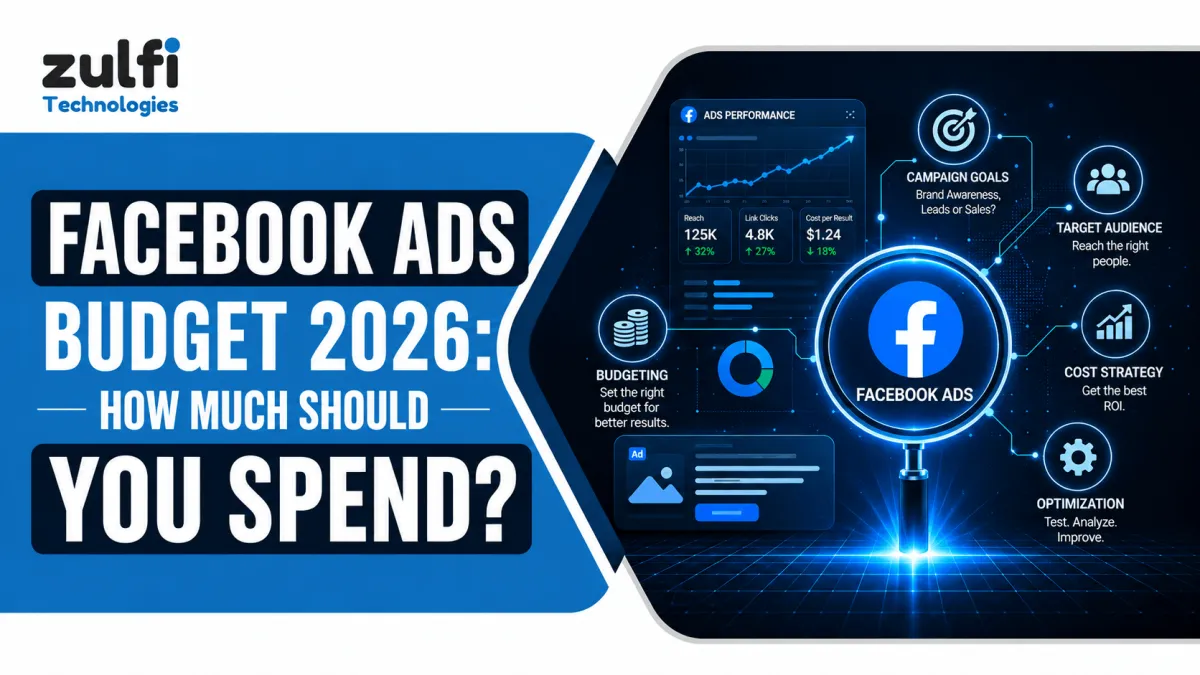
Ask ten business owners how much they spend on Facebook ads and you'll get ten different answers — and most of them are guessing. Some are burning $50 a day with nothing to show for it. Others are stuck at $5 a day, wondering why the algorithm never seems to "figure them out." The truth is, your facebook ads budget isn't a fixed number. It's a formula, and once you understand the inputs, the guesswork disappears.
This guide breaks down what Facebook Ads actually cost in 2026, how to calculate a facebook advertising budget that fits your business, and when it makes sense to scale up or pull back.
Key Takeaways
Facebook ad costs in 2026 average around $0.70 per click, with cost per lead sitting near $27.66, though your actual numbers will vary by industry and creative quality.
Meta's minimum effective budget depends on your objective — roughly $1/day for awareness, $5/day for clicks, and $10-$20/day for conversions.
Most small businesses realistically test with $300-$600/month before scaling, and a common rule of thumb is putting 5% to 12% of overall revenue into marketing, then allocating a slice to paid social.
More than 80% of businesses report Facebook advertising is worth the investment, but ROI depends heavily on budget discipline, not just spend size.
The smartest advertisers budget around target cost-per-acquisition and lifetime customer value, not an arbitrary daily number.
How Much Do Facebook Ads Cost in 2026?
Facebook ad costs are usually measured in three ways: cost per click (CPC), cost per thousand impressions (CPM), and cost per lead (CPL). Current 2026 industry benchmarks put average CPC around $0.68, CPM around $12.50, and CPL around $21.98, though these numbers shift depending on your industry, audience, and time of year.
Broadly, Facebook ads run $0.30 to $4.00 per click and $3 to $20 per 1,000 impressions, which is a wide range — and that range is exactly why a single "average cost" figure isn't that useful for planning your own budget. A local service business targeting a tight geographic radius will see very different numbers than an ecommerce brand running national campaigns.
What drives your Facebook ad costs up or down:
Campaign objective — conversion campaigns typically cost more per result than awareness or traffic campaigns.
Audience competition — broad, high-demand audiences (think: "women 25-45 interested in fitness") cost more than niche, specific ones.
Creative quality — ads that get more engagement lower your effective cost because Meta rewards relevance.
Seasonality — Q4 and holiday periods see costs spike as more advertisers compete for the same inventory.
What Is the Minimum Budget for Facebook Ads?
You can technically launch a campaign with $1 a day, but that doesn't mean it will perform. Meta's minimum effective budget varies by objective — around $1/day for awareness campaigns, $5/day for click campaigns, $10-$20/day for conversion campaigns, and $40 or more per day for app install campaigns.
The reason minimums matter so much is Meta's "learning phase." Every new ad set needs roughly 50 conversions within a week to exit this phase and start delivering efficiently. A simple way to estimate your minimum daily budget is: (Expected Cost Per Acquisition × 50) ÷ 7. If your target CPA is $30, that puts your minimum daily budget around $214 to give the algorithm enough data to optimize properly.
Underfund a campaign below this threshold, and you're not really testing Facebook ads — you're just feeding the algorithm too little data to ever leave the learning phase.
How Much Should You Spend on Facebook Ads Per Day?
For most small businesses just getting started, testing with $10 to $20 per day — roughly $300 to $600 a month — gives Meta's algorithm enough data to optimize without risking your entire budget before you know what works.
From there, the right daily spend depends on three things:
Your target cost per acquisition (CPA). Know what you can afford to pay for a lead or sale before you launch, not after.
Your industry's typical costs. Landing page conversion rates run 2-3% for ecommerce and 10-20% for lead-generation forms — a lead-gen business can often work with a smaller budget and still hit volume goals.
How fast you want data. A bigger daily budget gets you statistically reliable results faster; a smaller one stretches the same learnings over more time.
Give any new campaign at least 14 days before making a judgment call — audience behavior shifts throughout the week, and early data is rarely the full picture.
What Percentage of Your Marketing Budget Should Go to Facebook Ads?
There's no single right percentage, but there is a useful framework. A common guideline is to invest 5% to 12% of overall revenue into marketing, then allocate a portion of that to paid social based on where your customers actually spend their attention. If your customers live on Facebook and Instagram — which is true for most local and consumer-facing businesses — paid social deserves a meaningful slice of that budget.
On the spending side, most businesses allocate 0% to 15% of their total advertising budget specifically to Facebook ads, and 63% of businesses spend between $1 and $500 per month — though this typically reflects businesses still in the testing phase rather than ones actively scaling a proven campaign.
How Do You Optimize and Scale a Facebook Ads Budget?
Facebook advertisers rarely have a spending problem — they have a budget optimization problem. A campaign run on $50 a day with a strong strategy can outperform a competitor spending 10 times as much without one. Here's a practical framework for scaling a facebook ads budget the right way:
Set your target CPA before launch, not after. Know your break-even point so every scaling decision is based on math, not guesswork.
Let campaigns exit the learning phase before judging them. Resist the urge to pause or edit an ad set in its first week.
Scale gradually, not overnight. Increasing budget by more than 20% in a single day can reset the learning phase and spike your costs temporarily.
Reallocate toward what's working. Shift spend from underperforming ad sets to your best-performing audiences and creative on a weekly basis, not daily.
Track ROAS, not just cost. A campaign returning $3 for every $1 spent deserves more budget than a campaign you're nervously capping at $10/day because you're afraid to spend more.
Is Facebook Advertising Worth the Investment?
For most small businesses, yes. More than 80% of businesses report that Facebook advertising is worth the cost and are satisfied with the return on investment, largely due to the platform's targeting precision and reach.
That said, "worth it" depends entirely on whether you're tracking the right numbers — and whether your budget reflects clear objectives rather than a copy of last month's spend. If you haven't defined what success actually looks like for a campaign, it's worth revisiting how campaign goals shape ad strategy before setting next month's numbers, since the same principle applies whether you're running Google or Facebook Ads.
Facebook Ads Budget by Business Goal
Your budget should shift depending on what you're actually trying to achieve:
Brand awareness: Objective, reach and impressions; Budget approach, lower daily spend spread over a longer flight, optimized for CPM rather than CPA.
Lead generation: Objective, cost per lead; Budget approach, mid-range daily spend ($20-$50+), tightly monitored CPL against your sales close rate.
Ecommerce sales: Objective, ROAS; Budget approach, budget scaled aggressively once ROAS is proven, often the highest daily spend of the three.
App installs: Objective, cost per install; Budget approach, highest minimum threshold, generally $40+/day to exit the learning phase.
If you're weighing Facebook against other channels for the same budget, it's worth comparing against Google Ads too — the two platforms reward very different budget strategies depending on your objective.
We help businesses earn trust across search, content, automation, and AI experiences. Our focus stays practical, clear, and accountable, so progress remains visible and performance improves steadily over time.
In this article
Custom App Development
Facebook Ads Budget FAQs
What is a good budget for Facebook ads?
For most small businesses, $300-$600 a month ($10-$20/day) is a reasonable starting point for testing, with budget increasing once a campaign proves profitable.
How much should I spend on Facebook ads per day?
It depends on your target cost per acquisition, but most conversion campaigns need at least $10-$20/day to exit Meta's learning phase and deliver reliable data.
How much do Facebook ads cost in 2026?
Average costs run around $0.68-$0.70 per click and $12-$20 per 1,000 impressions, though actual costs vary significantly by industry, audience, and objective.
What percentage of my marketing budget should go to Facebook ads?
Most businesses allocate 0-15% of their total ad budget to Facebook, guided by a broader rule of investing 5-12% of revenue into marketing overall.
Is Facebook advertising worth the investment?
For the large majority of businesses, yes — over 80% report satisfaction with their Facebook ad ROI, provided the budget is managed against a clear target CPA.
How long should I run a Facebook ad before judging the results?
At least 14 days. Meta's algorithm needs time and consistent data to exit the learning phase and optimize delivery.
What is the minimum budget for Facebook ads?
Technically $1/day, but effective minimums are closer to $5/day for click campaigns, $10-$20/day for conversions, and $40+/day for app installs.
Set Your Facebook Ads Budget With Confidence, Not Guesswork
There's no universal answer to "how much should I spend on Facebook ads" — but there is a reliable process. Start with your target CPA, size your daily budget around Meta's learning-phase requirements, give campaigns enough time to perform, and scale based on ROAS rather than instinct.
Key actions to take from this guide:
Calculate your minimum daily budget using (Target CPA × 50) ÷ 7 before launching any conversion campaign.
Start with $10-$20/day if you're new to Facebook ads, and commit to at least 14 days before judging performance.
Allocate your Facebook ads budget as a percentage of overall marketing spend (5-12% of revenue), not as a flat guess.
Scale winning campaigns by 20% increments, not overnight jumps, to avoid resetting the learning phase.
A facebook ads budget only works when it's built around your numbers — your CPA, your margins, your customer lifetime value — not somebody else's benchmark. If you'd rather have that strategy built and managed for you, our Content Marketing and paid media team can handle both the creative and the spend planning together.
Book a Consultation
Let Zulfi Tech Build a Facebook Ads Budget That Actually Performs
Partner with our experts to plan, launch, and scale Facebook Ad campaigns built around real numbers, not guesswork.

About author
I am a passionate writer with a strong interest in IT and marketing, focused on sharing practical ideas in simple and clear language. I enjoy helping readers understand technology and marketing concepts easily, making them useful for everyday work and growth.


Let's Connect With Our Experts

AI-powered digital marketing solutions for businesses ready to dominate search and AI-driven discovery.
Copyright© 2026 Zulfi Technologies. All rights reserved.